 Upload BOM

650V Gallium Nitride is Reshaping the Future of Motor Control
12/17/2025 8:51:16 PM
Gallium nitride (GaN) high electron mobility transistors (HEMTs) have become a transformative technology in power electronics. Initially developed for high-frequency applications (RF), GaN technology has since distinguished itself in fast-charging solutions due to its superior performance compared to traditional silicon-based semiconductors.
GaN is a wide-bandgap semiconductor with high electron mobility, allowing it to withstand higher voltages, operate at higher frequencies, and generate less heat. These characteristics make GaN ideal for compact, efficient, and fast-charging solutions-perfect for ubiquitous devices such as smartphones and laptops.
Since most commercially available GaN transistors are rated at 650V, they are also well-suited for high-voltage motor drive applications. Key advantages include higher power density and efficiency, less heat dissipation, and a compact system design, enabling high-speed and precise motor control. This is particularly advantageous in industries with extremely high space and energy efficiency requirements, such as robotics, spacecraft, electric vehicles, and drones.
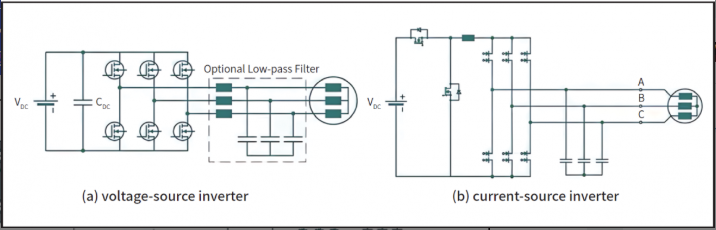
By switching each branch to the bus voltage (VDC) or ground, the inverter generates a modulated voltage waveform at each switching node. These voltages are then filtered by the motor windings (or, if necessary, an external low-pass filter) to produce a three-phase sinusoidal output voltage with a 120° phase shift. The inverter uses pulse-width modulation (PWM) technology to regulate the output voltage and frequency, thereby controlling the motor's speed and torque.
Key Requirements of Three-Phase Inverters
During inverter operation, charge inevitably flows through the switched capacitors. In MOSFETs, this is related to the output capacitance; however, in IGBTs, the situation is different due to the presence of anti-parallel diodes.
To prevent shoot-through (i.e., two switches in the same phase turning on simultaneously), a dead time must be introduced to ensure that both switches remain off for a short period. During this time, current flows through the body diode of the MOSFET or the external anti-parallel diode in the IGBT design as energy continues to flow into the motor.
The diode requires reverse recovery charge (Qrr) to turn off, which happens precisely at the worst moment-when the voltage across the switch reaches its peak. This process generates switching losses, thus reducing the overall efficiency of the inverter.
GaN Technology Significantly Improves Efficiency
In motor drive applications, minimizing conduction and switching losses is crucial for reducing energy waste and improving efficiency. Furthermore, fast switching speeds improve motor control accuracy and reduce harmonic distortion, while high power density and space constraints necessitate compact and lightweight designs.
At a developer forum focused on wide bandgap technologies, Infineon Technologies highlighted the advantages of GaN technology in motor drives. Figure 2 shows a comparison table listing key performance parameters affecting motor drive operation, particularly comparing the 6A IGBT and 140mΩ GaN HEMT from Infineon's CoolGaN series.
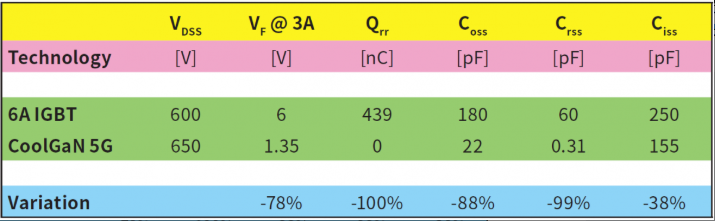
When using 650V GaN devices, all key parameters affecting motor drive operation are systematically improved. For example, eliminating Qrr significantly reduces conduction losses, especially at the end of the dead zone of GaN device conduction.
Furthermore, lower input capacitance minimizes drive losses, and lower reverse transfer capacitance (Crss, also known as Miller capacitance) is particularly advantageous in three-phase inverters. Reducing Crss reduces sensitivity to parasitic conduction, thereby reducing the risk of shoot-through.
Notably, GaN HEMTs also have the potential for monolithic integration with sense resistors and built-in short-circuit protection, further enhancing system reliability and performance.
High-Frequency Operation
As switching frequencies increase, high-frequency ringing occurs on the motor due to factors such as signal reflection (caused by cable length) and inter-winding capacitance. These high-frequency oscillations lead to energy loss because only the fundamental frequency generates torque. To mitigate these effects, an optional low-pass filter can be used.
By separating high-frequency components from low-frequency waveforms, increasing the switching frequency reduces the high-frequency envelope, thereby reducing high-frequency motor losses that are primarily dependent on current ripple. However, excessively high switching frequencies increase inverter losses, while GaN transistors offer a significant advantage due to their low power consumption.
Optimal Switching Frequency
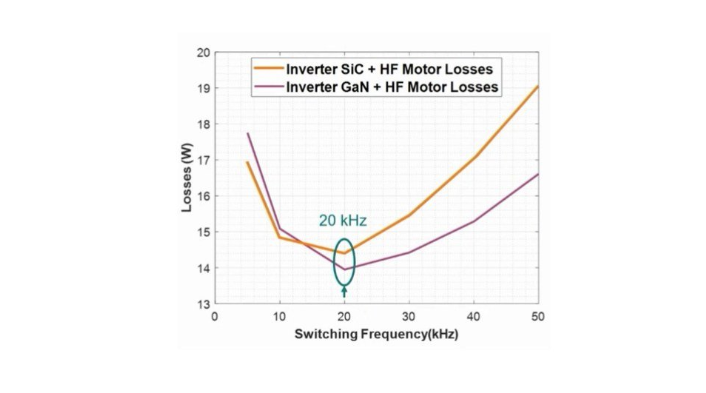
A typical 3-horsepower high-voltage permanent magnet synchronous motor operates at 1800 rpm on a 320V, 12.5A power supply. To determine the optimal switching frequency, inverter losses and high-frequency motor losses in silicon carbide (SiC) and GaN-based designs can be analyzed.
As shown in Figure 3, the frequency that minimizes total losses is approximately 20kHz. Operating at this frequency also extends motor life, making it a practical choice for consumer-grade motor drives.
In traditional silicon-based technologies using IGBTs or superjunction CoolMOS, heatsinks are unnecessary for power ratings below 300W, provided a smart power module solution is employed or a sufficiently large PCB is available for discrete device designs. However, in the 300-500W range, heatsinks and cooling fans become essential.
With GaN switches, the power range without heatsinks can be extended to 1kW thanks to innovative packaging technology. Furthermore, GaN technology offers significant energy savings in the 1-3kW range, reducing the need for heat dissipation.
BLDC and CoolGaN Evaluation Board: Infineon has developed an evaluation board for brushless DC (BLDC) motors driven by an inverter based on 140mΩ CoolGaN transistors (in a 5×6 ThinPAK package). Due to its high efficiency, the system operates without a heatsink, with a maximum temperature below 75°C at 1kW power.
Key operating conditions include: 1kHz switching frequency, 10V/ns slew rate, 200ns dead time, and 2.5ARMS current.
At 100% and 50% load, this configuration achieves up to 70% energy savings compared to a 6A IGBT. Additionally, GaN's smoother switching characteristics reduce electromagnetic interference (EMI) radiation even at higher slew rates. This may seem counterintuitive, as GaN HEMTs have a higher dV/dt. However, their cleaner switching characteristics, lack of reverse recovery, lower common-mode noise, and optimized packaging result in lower total EMI radiation compared to slower-switching silicon devices. This can be achieved simply by considering the reduction in dwell time in the nonlinear region, thus shortening the time for radiated EMI generated by the high dV/dt and di/dt interactions.
Infineon also claims that its new integrated CoolGaN driver, when used in conjunction with the PSoC Control C3 microcontroller (MCU) and XENSIV current sensor, enables higher power density.
Future Developments of Bidirectional GaN HEMTs
Current source inverters (CSI, see Figure 1b) use inductors to maintain a constant current, requiring a continuous conduction path. If the current is interrupted, high-voltage spikes can occur, damaging the inductor or other circuit components.
CSI topologies require bidirectional switches capable of blocking bidirectional voltages while allowing unidirectional current flow. This is because the inverter topology experiences voltages of different polarities at the switching terminals. Bidirectional voltage blocking ensures that the switch can withstand and isolate reverse voltages, preventing accidental current conduction and component damage.
Unlike traditional silicon devices that require bulky diodes in series for voltage blocking, GaN HEMTs are inherently bidirectional, typically using a common-source configuration of two HEMTs. By utilizing GaN-based bidirectional switching, CSI topologies can operate at higher switching frequencies, allowing for the use of smaller passive components and improved overall system efficiency. This makes GaN-powered CSI highly attractive in high-performance motor drives, grid-connected inverters, and aerospace power electronics.
Advantages of CSI Topologies
CSI offers numerous advantages in specific motor drive applications, such as high-power industrial motors and renewable energy systems. Key advantages include:
Inherent Short-Circuit Protection: Fault current is naturally limited due to inductor regulation of the DC-side current, improving system reliability.
Regenerative Braking Capability: CSI smoothly transfers energy back to the DC power supply, improving efficiency and saving energy.
Enhanced Motor Performance: CSI provides a near-sinusoidal current waveform, extending motor life and reducing motor heating and torque ripple.
Reduced output filter requirements: Compared to VSI, CSI produces lower harmonic distortion, thereby minimizing the need for large passive filters.
GaN is a wide-bandgap semiconductor with high electron mobility, allowing it to withstand higher voltages, operate at higher frequencies, and generate less heat. These characteristics make GaN ideal for compact, efficient, and fast-charging solutions-perfect for ubiquitous devices such as smartphones and laptops.
Since most commercially available GaN transistors are rated at 650V, they are also well-suited for high-voltage motor drive applications. Key advantages include higher power density and efficiency, less heat dissipation, and a compact system design, enabling high-speed and precise motor control. This is particularly advantageous in industries with extremely high space and energy efficiency requirements, such as robotics, spacecraft, electric vehicles, and drones.
Three-Phase Inverters for Motor Control
By switching each branch to the bus voltage (VDC) or ground, the inverter generates a modulated voltage waveform at each switching node. These voltages are then filtered by the motor windings (or, if necessary, an external low-pass filter) to produce a three-phase sinusoidal output voltage with a 120° phase shift. The inverter uses pulse-width modulation (PWM) technology to regulate the output voltage and frequency, thereby controlling the motor's speed and torque.
Key Requirements of Three-Phase Inverters
During inverter operation, charge inevitably flows through the switched capacitors. In MOSFETs, this is related to the output capacitance; however, in IGBTs, the situation is different due to the presence of anti-parallel diodes.
To prevent shoot-through (i.e., two switches in the same phase turning on simultaneously), a dead time must be introduced to ensure that both switches remain off for a short period. During this time, current flows through the body diode of the MOSFET or the external anti-parallel diode in the IGBT design as energy continues to flow into the motor.
The diode requires reverse recovery charge (Qrr) to turn off, which happens precisely at the worst moment-when the voltage across the switch reaches its peak. This process generates switching losses, thus reducing the overall efficiency of the inverter.
GaN Technology Significantly Improves Efficiency
In motor drive applications, minimizing conduction and switching losses is crucial for reducing energy waste and improving efficiency. Furthermore, fast switching speeds improve motor control accuracy and reduce harmonic distortion, while high power density and space constraints necessitate compact and lightweight designs.
At a developer forum focused on wide bandgap technologies, Infineon Technologies highlighted the advantages of GaN technology in motor drives. Figure 2 shows a comparison table listing key performance parameters affecting motor drive operation, particularly comparing the 6A IGBT and 140mΩ GaN HEMT from Infineon's CoolGaN series.
When using 650V GaN devices, all key parameters affecting motor drive operation are systematically improved. For example, eliminating Qrr significantly reduces conduction losses, especially at the end of the dead zone of GaN device conduction.
Furthermore, lower input capacitance minimizes drive losses, and lower reverse transfer capacitance (Crss, also known as Miller capacitance) is particularly advantageous in three-phase inverters. Reducing Crss reduces sensitivity to parasitic conduction, thereby reducing the risk of shoot-through.
Notably, GaN HEMTs also have the potential for monolithic integration with sense resistors and built-in short-circuit protection, further enhancing system reliability and performance.
High-Frequency Operation
As switching frequencies increase, high-frequency ringing occurs on the motor due to factors such as signal reflection (caused by cable length) and inter-winding capacitance. These high-frequency oscillations lead to energy loss because only the fundamental frequency generates torque. To mitigate these effects, an optional low-pass filter can be used.
By separating high-frequency components from low-frequency waveforms, increasing the switching frequency reduces the high-frequency envelope, thereby reducing high-frequency motor losses that are primarily dependent on current ripple. However, excessively high switching frequencies increase inverter losses, while GaN transistors offer a significant advantage due to their low power consumption.
Optimal Switching Frequency
A typical 3-horsepower high-voltage permanent magnet synchronous motor operates at 1800 rpm on a 320V, 12.5A power supply. To determine the optimal switching frequency, inverter losses and high-frequency motor losses in silicon carbide (SiC) and GaN-based designs can be analyzed.
As shown in Figure 3, the frequency that minimizes total losses is approximately 20kHz. Operating at this frequency also extends motor life, making it a practical choice for consumer-grade motor drives.
In traditional silicon-based technologies using IGBTs or superjunction CoolMOS, heatsinks are unnecessary for power ratings below 300W, provided a smart power module solution is employed or a sufficiently large PCB is available for discrete device designs. However, in the 300-500W range, heatsinks and cooling fans become essential.
With GaN switches, the power range without heatsinks can be extended to 1kW thanks to innovative packaging technology. Furthermore, GaN technology offers significant energy savings in the 1-3kW range, reducing the need for heat dissipation.
BLDC and CoolGaN Evaluation Board: Infineon has developed an evaluation board for brushless DC (BLDC) motors driven by an inverter based on 140mΩ CoolGaN transistors (in a 5×6 ThinPAK package). Due to its high efficiency, the system operates without a heatsink, with a maximum temperature below 75°C at 1kW power.
Key operating conditions include: 1kHz switching frequency, 10V/ns slew rate, 200ns dead time, and 2.5ARMS current.
At 100% and 50% load, this configuration achieves up to 70% energy savings compared to a 6A IGBT. Additionally, GaN's smoother switching characteristics reduce electromagnetic interference (EMI) radiation even at higher slew rates. This may seem counterintuitive, as GaN HEMTs have a higher dV/dt. However, their cleaner switching characteristics, lack of reverse recovery, lower common-mode noise, and optimized packaging result in lower total EMI radiation compared to slower-switching silicon devices. This can be achieved simply by considering the reduction in dwell time in the nonlinear region, thus shortening the time for radiated EMI generated by the high dV/dt and di/dt interactions.
Infineon also claims that its new integrated CoolGaN driver, when used in conjunction with the PSoC Control C3 microcontroller (MCU) and XENSIV current sensor, enables higher power density.
Future Developments of Bidirectional GaN HEMTs
Current source inverters (CSI, see Figure 1b) use inductors to maintain a constant current, requiring a continuous conduction path. If the current is interrupted, high-voltage spikes can occur, damaging the inductor or other circuit components.
CSI topologies require bidirectional switches capable of blocking bidirectional voltages while allowing unidirectional current flow. This is because the inverter topology experiences voltages of different polarities at the switching terminals. Bidirectional voltage blocking ensures that the switch can withstand and isolate reverse voltages, preventing accidental current conduction and component damage.
Unlike traditional silicon devices that require bulky diodes in series for voltage blocking, GaN HEMTs are inherently bidirectional, typically using a common-source configuration of two HEMTs. By utilizing GaN-based bidirectional switching, CSI topologies can operate at higher switching frequencies, allowing for the use of smaller passive components and improved overall system efficiency. This makes GaN-powered CSI highly attractive in high-performance motor drives, grid-connected inverters, and aerospace power electronics.
Advantages of CSI Topologies
CSI offers numerous advantages in specific motor drive applications, such as high-power industrial motors and renewable energy systems. Key advantages include:
Inherent Short-Circuit Protection: Fault current is naturally limited due to inductor regulation of the DC-side current, improving system reliability.
Regenerative Braking Capability: CSI smoothly transfers energy back to the DC power supply, improving efficiency and saving energy.
Enhanced Motor Performance: CSI provides a near-sinusoidal current waveform, extending motor life and reducing motor heating and torque ripple.
Reduced output filter requirements: Compared to VSI, CSI produces lower harmonic distortion, thereby minimizing the need for large passive filters.